Sunday, May 27, 2018

Forget North Korea, Buy These Four Defense Stocks Now

&l;p&g;Defense and aerospace stocks are finally starting to go down. And that&a;rsquo;s good news. In fact, if you are a longer-term investor, this is your wakeup call.

In a report to clients April 26, Rajeev Lalwani, a Morgan Stanley analyst, notes the sector is down 6% despite generally upbeat first-quarter earnings results, and guidance increases from leading firms.

&l;img class=&q;dam-image ap size-large wp-image-5c2427dd3fea4a7ab62bd2aec95daa60&q; src=&q;https://specials-images.forbesimg.com/dam/imageserve/5c2427dd3fea4a7ab62bd2aec95daa60/960x0.jpg?fit=scale&q; data-height=&q;639&q; data-width=&q;960&q;&g; Secretary of Defense Jim Mattis, speaks to reporters about North Korea, at the Pentagon, Friday, May 25, 2018. (AP Photo/Manuel Balce Ceneta)

Defense and aerospace stocks have been on a roll for a very long time. Most started their ascent after the 9/11 terror attacks. That catastrophic event changed the rules of the game. Security became paramount. So much so that spending on very expensive weapons of war has become an untouchable fact of life, even in highly partisan Washington.

&l;p class=&q;tweet_line&q;&g;Decades removed from the Vietnam War, neither political party can afford to appear anti-military .

Despite&a;nbsp;&l;a href=&q;https://www.usatoday.com/story/money/economy/2018/04/11/inflation-heating-up-consumer-prices-rising-faster/506350002/&q; target=&q;_blank&q; rel=&q;noopener noreferrer&q; target=&q;_blank&q;&g;growing inflation fears&l;/a&g;&a;nbsp;and rising interest rates due to ballooning budget deficits, there is not even a whisper about curtailing Pentagon support. Democrats and Republicans disagree about almost everything &a;hellip; except military spending. In February, they agreed to $165 billion in&a;nbsp;&l;a href=&q;https://www.reuters.com/article/legal-us-usa-congress-shutdown/u-s-senate-leaders-reach-300-billion-federal-spending-deal-idUSKBN1FS0AY&q; target=&q;_blank&q; rel=&q;noopener noreferrer&q; target=&q;_blank&q;&g;additional funds&l;/a&g;&a;nbsp;for the Department of Defense.

The extra money fully funds the National Defense Authorization Act, a $700 billion package&a;nbsp;&l;a href=&q;https://www.reuters.com/article/us-usa-defense-congress/senate-backs-massive-increase-in-military-spending-idUSKCN1BT2PV&q; target=&q;_blank&q; rel=&q;noopener noreferrer&q; target=&q;_blank&q;&g;passed by the Senate&l;/a&g;&a;nbsp;last September on an 89-to-8 vote. Of that figure, the Associated Press&a;nbsp;&l;a href=&q;http://www.wboy.com/news/a-budget-the-likes-of-which-the-pentagon-has-never-seen/963674019&q; target=&q;_blank&q; rel=&q;noopener noreferrer&q; target=&q;_blank&q;&g;reports&l;/a&g;&a;nbsp;$603 billion will be used for core Pentagon operations like missile defense, machinery and buildings. In 2019, the Pentagon budget will rise again, to $719 billion.

By way of comparison, the budget was $345 billion in 2002.

&l;!--nextpage--&g;

Defense businesses are already starting to see some of the benefits of looser purse strings.&a;nbsp;&l;strong&g;General Dynamics (GD)&l;/strong&g;,&a;nbsp;&l;strong&g;Lockheed Martin (LMT)&l;/strong&g;&a;nbsp;and&a;nbsp;&l;strong&g;Northrop Grumman (NOC)&l;/strong&g;&a;nbsp;reported first-quarter financial results that soundly beat the consensus view.&a;nbsp;&l;a href=&q;https://www.cnbc.com/2018/04/24/lockheed-martin-earnings-q1-2018.html&q; target=&q;_blank&q; rel=&q;noopener noreferrer&q; target=&q;_blank&q;&g;Lockheed&l;/a&g;&a;nbsp;and&a;nbsp;&l;a href=&q;https://www.ft.com/content/6d4ae292-47ec-11e8-8ee8-cae73aab7ccb&q; target=&q;_blank&q; rel=&q;noopener noreferrer&q; target=&q;_blank&q;&g;Northrop&l;/a&g;&a;nbsp;even raised guidance.

And all of the companies talked about better earnings visibility through the end of the decade.

That&a;rsquo;s a big deal. Not only should investors expect growth to continue, companies can now plan for it.&a;nbsp;This will probably mean increased dividends and share repurchase programs. The return of capital is bullish for investors.

I&a;rsquo;m especially excited about what these companies are doing in space.

Aerospace gets very little respect. That&a;rsquo;s because for a long time, the space business was terrible. The NASA program was/is widely viewed as broken. And in an age of political budget squabbles, plus the fear of being soft on defense, project cuts became common.

Aerospace is in the midst of a renaissance. Everything is coming together at the same time &a;hellip;

&l;/p&g;&l;blockquote&g;&a;bull;&a;nbsp;Launch costs have been reduced with reusable rockets.

&a;bull;&a;nbsp;Satellite technology has been made cheaper by smartphone development.

&a;bull;&a;nbsp;Demand for bandwidth remains insatiable.

&l;!--nextpage--&g;

&a;bull;&a;nbsp;And private investors and national security gatekeepers are funneling money toward new projects at breakneck pace.&l;/blockquote&g;

Most of the buzz is around&a;nbsp;&l;a href=&q;https://www.nasa.gov/mission_pages/station/research/benefits/commercialization_leo&q; target=&q;_blank&q; rel=&q;noopener noreferrer&q; target=&q;_blank&q;&g;low earth orbit&l;/a&g;&a;nbsp;satellites. Unlike satellites of the past, these devices operate much closer to Earth, at 100 to 1,240 miles. This means higher resolution images, lower latency communication, much lower launch costs and reduced wear and tear on parts. Many LEO satellites use components developed for commercial smartphones and laptops.

I have been bullish on defense and aerospace stocks for a long time. I recommended them originally for the exposure to increased defense budgets. These days, I&a;rsquo;m excited about the aerospace end of the businesses.

I have been telling my newsletter members to use every meaningful decline to buy leading businesses like&a;nbsp;&l;strong&g;Boeing (BA)&l;/strong&g;, Lockheed, Northrop and&a;nbsp;&l;strong&g;Heico Corp. (HEI)&l;/strong&g;.

Heico may not be on your radar. It is a smaller company that makes high quality, non-original equipment for the aerospace and aviation sectors.

It&a;rsquo;s a niche market that Heico is dominating.

In this new era of space, its satellite microwave module, and integrated subsystems businesses are booming.

The company is growing fast, through continual acquisitions. At the same time, managers have maintained gross margins of 40%, and operating margins above 20%.

Since 2013, sales have grown from $1.01 billion, to $1.52 billion. In fiscal 2017, revenues surged 10.8%, far better than the industry average.

The stock has pulled back from its record high near $94. It currently trades at $88.40. And that is great news for longer-term investors.

Saturday, May 26, 2018

This Rare-Disease Biotech Scores an Important Win

After the FDA approved Palynziq (formerly pegvaliase) for use in adults with phenylketonuria (PKU), a rare genetic disease, this week,�BioMarin Pharmaceutical�(NASDAQ:BMRN)�is in a great position to add hundreds of millions of dollars in new revenue to its top line. BioMarin already markets one PKU therapy, Kuvan, so it should be able to hit the ground running. Is BioMarin a stock worth buying now?

What is PKU?

A genetic disease caused by an inability to break down an amino acid, PKU can result in the toxic buildup of phenylalanine in the brain, particularly if patients consume�protein-rich foods or foods containing aspartame, an artificial sweetener.

A person holds a rubber stamp in his hand with the word approved printed on it.

IMAGE SOURCE: GETTY IMAGES.

As phenyalanine levels increase to dangerous levels, it can cause irreversible brain damage, developmental delays, and neurological problems, including seizure. It's a severe condition, but it's relatively rare. Globally, it impacts about 50,000 people.�

Because PKU is debilitating, all 50 states in the U.S. require PKU screening at birth. There's no cure for PKU, so treatment involves a lifelong dietary restriction that's very hard for patients to comply with. In�some PKU patients,�BioMarin's Kuvan, a pharmaceutical version of BH4, a natural substance that reduces phenyalanine levels by breaking it down, is also prescribed.

Currently, only about 12% of PKU patients, most of whom are children, take Kuvan, yet it's BioMarin's second best-selling product, with $408 million in sales in 2017.

Reaching more PKU patients

Palynziq is a potent drug, and because of this, it's initially only being approved for use in adults with PKU. BioMarin believes roughly 12,000 adults in the U.S. could benefit from using its newly approved drug and that its worldwide addressable market totals about 33,000 people.�

An enzyme replacement approach, Palynziq substitutes the deficient phenylalanine enzyme in PKU with a version of the enzyme phenylalanine ammonia lyase, which can break down�phenyalanine.�

Immune responses, including anaphylaxis, occurred in Palynziq's trials, so the FDA approval includes a REMS program, and the dosing of it in patients will be titrated over four to six months to improve tolerability and so that patients can take the lowest effective dose. In trials, 11% of patients discontinued Palynziq because of adverse reactions.�

While safety concerns can't be ignored, Palynziq is a first-of-its-kind solution for adult patients, and its efficacy could allow BioMarin to treat substantially more PKU patients than Kuvan. According to BioMarin's management, Palynziq has billion-dollar per year peak sales potential.

Initially, BioMarin's focus will be converting the 200 adult PKU patients that participated in Palynziq's trials into commercial users. Once that's done, the company will focus on the 2,300 adult Americans who are being treated in clinics, and then, it will embrace a strategy to reach the roughly 7,500 patients who are diagnosed with PKU, but who haven't sought out treatment at a clinic for at least two years.

BioMarin expects that Palynziq will be available commercially in late June at an average expected cost of $192,000 per patient per year. At that price, the company would generate $38.4 million in annual sales if it converts the 200 trial participants into regular patients and $480 million per year if it also successfully gets Palynziq prescribed to the 2,300 people being treated in clinics.�

Pricing isn't likely to be as high outside of the U.S., but the addressable market there is bigger, so an EU approval would also be meaningful.�EU regulators accepted Palynziq's application for approval earlier this year, and overall, management says there are 15,000 adult PKU patients in Europe and Turkey, including 4,900 who are being treated in clinics.

What's on deck

Kuvan's use in children should continue to make it a top-seller for the company, at least until generics become available. BioMarin has licensed rights to two generic drugmakers, and generic Kuvan could arrive�as soon as October 2020.

In the meantime, BioMarin will enjoy a dominant position in PKU that will help BioMarin take another step toward achieving profitability. Following Palynziq's OK, BioMarin has now won approvals for seven drugs. In 2017, the company's global revenue was $1.3 billion, so the potential to add hundreds of millions of dollars in new sales would significantly move the needle.�

BMRN Revenue (Annual) Chart

BMRN Revenue (Annual) data by YCharts.

In addition to improving progress toward profit, the additional revenue will also come in handy in support of BioMarin's R&D pipeline, including a potentially game-changing PKU gene therapy.�BioMarin hopes to begin human trials for a gene therapy that could restore the production of the missing enzyme in PKU patients in 2019.�The potential for a one-and-done gene therapy in PKU would significantly disrupt the market.

Overall, the impact Palynziq may have on BioMarin's financials in the next year or two, and the opportunity longer-term to create even better treatments for PKU, make it an interesting stock that I think is worth buying in growth portfolios.

Friday, May 25, 2018

Dow Jones Today Slides After White House Cancels North Korean Summit

The Dow Jones today dropped 60 points in pre-market hours, as markets processed developments between the Trump administration and the North Korean government. On Thursday, U.S. President Donald Trump announced he had canceled the planned summit between the United States and North Korean, on June 12. While disruptive to market stability, the cancellation isn't surprising to Money Morning. In fact, we saw it coming months ago.

Here are the numbers from Thursday for the Dow, S&P 500, and Nasdaq:

Index Previous Close Point Change Percentage Change
Dow Jones 24,811.76 -75.05 -0.30%
Nasdaq 7,424.43 -1.53 -0.02%
S&P 500 2,727.76 -5.53 -0.20%

Now here's a closer look at today's Money Morning insight, the most important market events, and stocks to watch.

Fast Money: This powerful secret made one man a millionaire. Now he's sharing it live on camera – find out how you could use it to become $2,918 richer in less than minute. Click here…

Money Morning Insight of the Day

It looks like the deal between Fox and Disney is about to die on the vine. And if you are smart enough to get out in front of this event, you could make 10 times your money.

We're about to reveal a little wealth secret that could unlock the trade of a lifetime.�Money Morning�Special Situation Strategist Tim Melvin takes you inside what could easily be a 10-bagger for investors in the weeks ahead.�Read more right here.

The Top Stock Market Stories for Friday Dow Jones Today Slides After White House Cancels North Korean SummitMeanwhile, the United States will continue to meet with China to discuss ways to accelerate a deal between the two nations on trade. U.S. Commerce head Wilbur Ross will be visiting the nation next month to lead the next round of talks. Last weekend, the two nations agreed in principle to avoid a trade war. Here's the thing… the U.S. government doesn't want you to know the full story of what is happening. Here's a look at the backroom details…. U.S. crude oil prices slumped below $70 per barrel Friday thanks to reports out of Russia on its plans to hike production. Russia says it may increase production as part of a plan to ease portions of its deal with OPEC to cap excessive global output. Oil traders have long suspected that Russia would be one of the first countries to turn away from the ongoing deal with Saudi Arabia and the rest of the global oil cartel as soon as prices and inventory levels stabilized. This could be a blow to predictions among OPEC nations, as well as some traders who were hoping that oil could push back toward $100 per barrel. Three Stocks to Watch Today: FL, NFLX, AMZN Foot Locker Inc.�(NYSE: FL) leads a light day of earnings reports. Shares of the shoe retailer popped 13% after the firm reported earnings per share (EPS) of $1.45. Wall Street had anticipated EPS of just $1.24. The retailer benefited from stronger same-store sales and higher revenue, which also beat Wall Street expectations. On Thursday, Netflix Inc. (Nasdaq: NFLX) surpassed The Walt Disney Co.�(NYSE: DIS) in market capitalization to become the most valuable media property on the planet. It's worth noting, however, that Netflix's market capitalization of $163 billion is being bolstered by a P/E ratio of 209, while Disney's market cap of $153 billion is supported by a P/E ratio of roughly 16. Amazon.com Inc.�(Nasdaq: AMZN) is under fire thanks to a major security lapse. According to a Portland-based family, an Amazon Echo secretly recorded their conversation only to randomly send it to a person on their contact list. The latest episode again raises concerns about voice-assistant devices as they continue to grow in popularity. The company said that Alexa has misinterpreted background conversation as commands to reach a contact. Other firms reporting earnings include Hibbett Sports Inc.�(NYSE: HIBB) and Buckle Inc. (NYSE: BKE).
Follow�Money Morning��on��Facebook,�Twitter, and�LinkedIn.

Join the conversation. Click here to jump to comments…

Thursday, May 24, 2018

Top Warren Buffett Stocks For 2019

tags:IYF,FELP,DWSN,GEL,

As one of the most respected stock-pickers of all time, Berkshire Hathaway (NYSE:BRK-A) (NYSE:BRK-B) CEO Warren Buffett's favorite investment for most Americans may come as a surprise. Instead of suggesting individual stocks, or even Berkshire Hathaway itself, Buffett feels that most Americans will do well by accumulating a position in a low-cost index fund over time.

However, this is Buffett's advice for most Americans. What would be the better choice for you -- an investment in a low-cost S&P 500 index fund like the Vanguard S&P 500 ETF (NYSEMKT:VOO), or shares of Berkshire Hathaway?

Image Source: The Motley Fool.

Don't expect Berkshire to repeat its past performance

Since Warren Buffett took control of Berkshire Hathaway in 1964, the stock has generated 20.9% annualized returns -- more than double those of the S&P 500. In fact, a $10,000 investment in Berkshire Hathaway when Buffett took over would be worth a staggering $240 million today, as compared to a respectable, but not breathtaking, $1.5 million from the same amount invested in the S&P 500.

Top Warren Buffett Stocks For 2019: Ishares Trust Dj Us Financial (IYF)

Advisors' Opinion:
  • [By Todd Shriber, ETF Professor]

    The challenges facing EUFN may indicate the ETF will be challenged to deliver compelling risk-reward for investors. EUFN's three-year standard deviation is 18.23 percent, or more than 500 basis points above the same metric on the iShares U.S. Financials ETF (NYSE: IYF).

Top Warren Buffett Stocks For 2019: Foresight Energy LP(FELP)

Advisors' Opinion:
  • [By Ethan Ryder]

    Foresight Energy (NYSE:FELP) – Analysts at B. Riley lifted their Q2 2018 earnings per share (EPS) estimates for Foresight Energy in a research report issued to clients and investors on Wednesday, May 9th. B. Riley analyst L. Pipes now forecasts that the energy company will post earnings of ($0.08) per share for the quarter, up from their previous forecast of ($0.12). B. Riley has a “Neutral” rating and a $4.00 price objective on the stock. B. Riley also issued estimates for Foresight Energy’s Q3 2018 earnings at ($0.07) EPS, Q4 2018 earnings at ($0.08) EPS, FY2018 earnings at ($0.35) EPS, FY2019 earnings at ($0.26) EPS and FY2020 earnings at ($0.39) EPS.

  • [By Joseph Griffin]

    Foresight Energy (NYSE:FELP) released its quarterly earnings results on Tuesday. The energy company reported ($0.15) earnings per share (EPS) for the quarter, missing analysts’ consensus estimates of ($0.07) by ($0.08), reports. Foresight Energy had a negative net margin of 18.78% and a negative return on equity of 3.93%.

Top Warren Buffett Stocks For 2019: Dawson Geophysical Company(DWSN)

Advisors' Opinion:
  • [By Logan Wallace]

    Dawson Geophysical (NASDAQ:DWSN) was upgraded by stock analysts at TheStreet from a “d+” rating to a “c-” rating in a research note issued on Monday.

Top Warren Buffett Stocks For 2019: Genesis Energy, L.P.(GEL)

Advisors' Opinion:
  • [By ]

    Genesis Energy LP (NYSE: GEL)
    Billing itself as a "growth-oriented master limited partnership," GEL concentrates its efforts on providing services around and within refineries primarily located on the Gulf Coast. Management is committed to logical double-digit growth as well as strengthening its distribution coverage. At $20.80 per unit, GEL yields 11.8% and trades at a nearly 40% discount to its 52-week high.

  • [By Lisa Levin] Companies Reporting Before The Bell Celgene Corporation (NASDAQ: CELG) is projected to report quarterly earnings at $1.96 per share on revenue of $3.46 billion. Aon plc (NYSE: AON) is expected to report quarterly earnings at $2.8 per share on revenue of $2.93 billion. American Axle & Manufacturing Holdings, Inc. (NYSE: AXL) is estimated to report quarterly earnings at $0.81 per share on revenue of $1.75 billion. Alibaba Group Holding Limited (NYSE: BABA) is expected to report quarterly earnings at $0.88 per share on revenue of $9.27 billion. LifePoint Health, Inc. (NASDAQ: LPNT) is projected to report quarterly earnings at $1.13 per share on revenue of $1.62 billion. V.F. Corporation (NYSE: VFC) is estimated to report quarterly earnings at $0.65 per share on revenue of $2.90 billion. Newell Brands Inc. (NYSE: NWL) is expected to report quarterly earnings at $0.26 per share on revenue of $3.05 billion. Titan International, Inc. (NYSE: TWI) is projected to report quarterly earnings at $0.04 per share on revenue of $407.27 million. Boise Cascade Company (NYSE: BCC) is expected to report quarterly earnings at $0.45 per share on revenue of $1.09 billion. Cheniere Energy, Inc. (NYSE: LNG) is estimated to report quarterly earnings at $0.39 per share on revenue of $1.59 billion. Cboe Global Markets, Inc. (NASDAQ: CBOE) is projected to report quarterly earnings at $1.24 per share on revenue of $308.05 million. ITT Inc. (NYSE: ITT) is estimated to report quarterly earnings at $0.73 per share on revenue of $683.96 million. Fred's, Inc. (NASDAQ: FRED) is expected to report quarterly loss at $0.19 per share on revenue of $551.00 million. Virtu Financial, Inc. (NASDAQ: VIRT) is projected to report quarterly earnings at $0.52 per share on revenue of $288.31 million. Cheniere Energy Partners, L.P. (NYSE: CQP) is expected to report quarterly earnings at $0.57 per share on revenue of $1.38 billion. Genesis Energy, L.P

Wednesday, May 23, 2018

EU's Corn-Buying Spree Is Boosting Rare Trade With South Africa

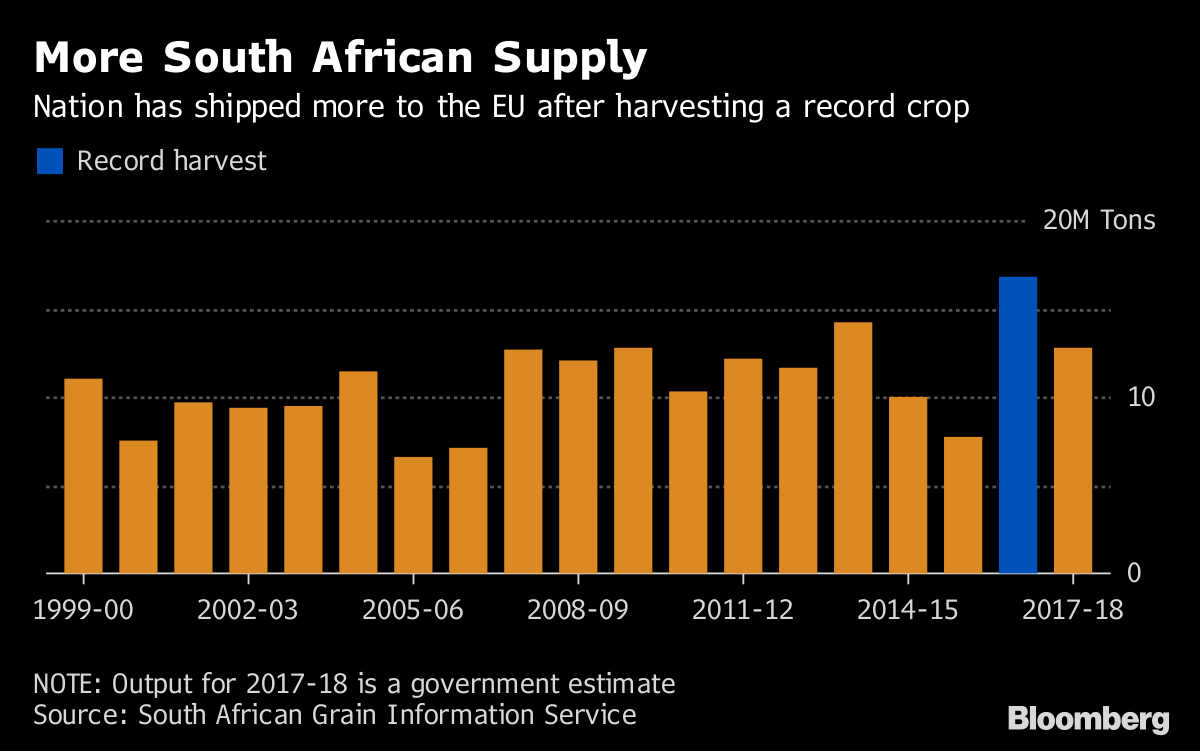
Europe’s hunger for corn is giving South Africa a surprising destination to sell more of its record crop.

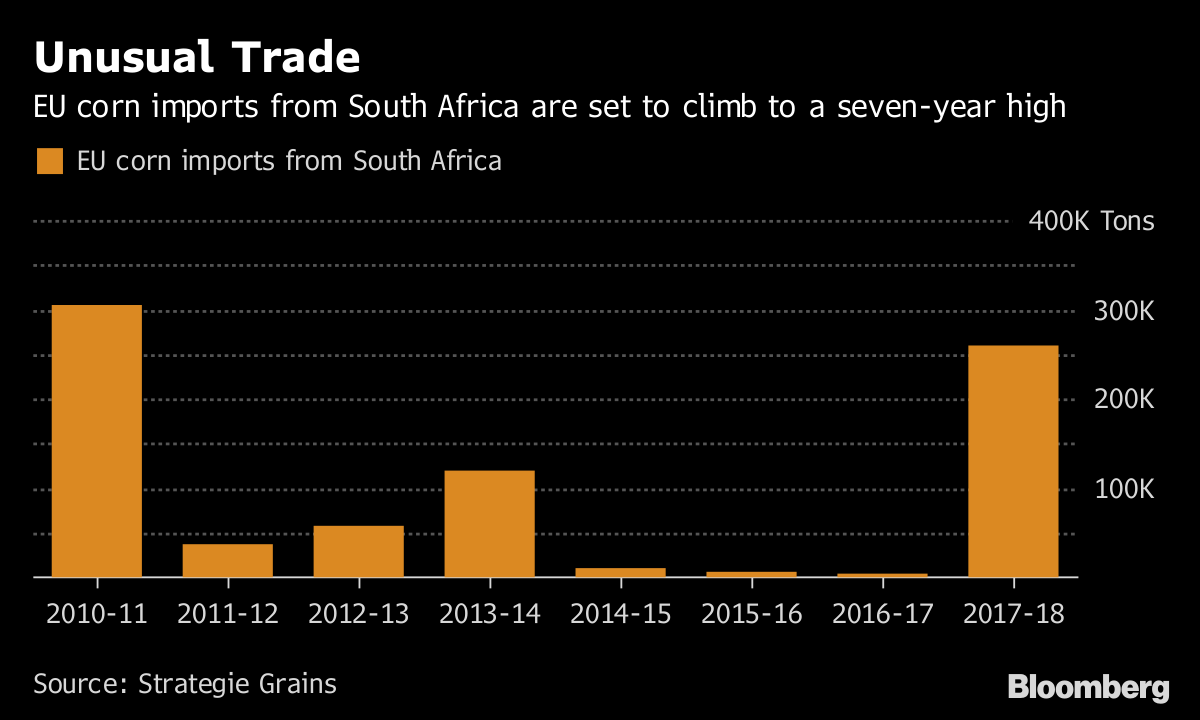
Africa’s top corn grower typically doesn’t export much to the European Union due to the long shipping distance and uncompetitive cost. But last year’s big harvest has cut prices, and should help South Africa ship more to the EU than in the previous six years combined, according to Strategie Grains.

Unusual Trade

EU corn imports from South Africa are set to climb to a seven-year high

Source: Strategie Grains

.chart-js { display: none; }

The increased trade comes as EU imports surged 41 percent this season amid strong demand for animal feed and cheap grain from more traditional suppliers such as Ukraine, Brazil and the U.S. Spain has accounted for all of the EU’s recent purchases from South Africa, whose last harvest more than doubled from a year earlier when the worst drought on record hurt crops.

“We have already seen a corn shipment from South Africa to Spain and several more are expected in May and June, which is very unusual,” Strategie Grains analyst Laurine Simon said. The “EU is not a usual market for South African corn because most of the time it’s too expensive to buy corn from South Africa. Even when South Africa exports, it usually does so to neighboring countries.”

Spain and Italy are forecast to import a combined 260,000 tons from South Africa in the 12 months ending September, the most in seven years, Strategie Grains estimates. South African prices have slumped at least 37 percent in the past two years, underperforming Ukrainian, U.S. and French grain.

More South African Supply

Nation has shipped more to the EU after harvesting a record crop

Source: South African Grain Information Service

NOTE: Output for 2017-18 is a government estimate

.chart-js { display: none; }

South African corn exports to Spain, the EU’s biggest grain importer and which is also recovering from a drought, have in the first two weeks of May already surpassed the entire previous 12-month period, South African Grain Information Service data show. Italy and Portugal have also imported in the past decade.

“Spain really surprised us by buying huge quantities of South African white corn because in the past it has not been a big market for us,” said Wandile Sihlobo, head agricultural economist at the Pretoria-based Agricultural Business Chamber. “We will be watching with interest to see how this evolves as we expect to see continued good demand for South African corn.”

The imports of South African corn are still a fraction of the amount the EU buys from Ukraine or Brazil. The African country recently started collecting its new harvest, which is expected to be close to the average over the past decade.

— With assistance by Liezel Hill

LISTEN TO ARTICLE 2:15 Share Share on Facebook Post to Twitter Send as an Email Print

Monday, May 21, 2018

Bank Indonesia to Step Up Intervention as Currency, Bonds Slide

Indonesia’s central bank pledged to continue its intervention in the currency and bonds market to ease volatility, and said it will boost forex liquidity as the rupiah slumped to a fresh 31-month low.

Bank Indonesia will hold three forex swap auctions to ensure sufficient liquidity in the interbank market, Nanang Hendarsah, executive director for monetary management, said in a text message on Monday. The bank, which usually holds two auctions a week, has been holding additional sales to ensure the market is well supplied, he said.

The rupiah slumped to its weakest level since October 2015 on Monday as rising U.S. Treasury yields and a firmer dollar trigger a selloff across emerging markets. Bank Indonesia’s pledge last week to add to its first interest rate hike since 2014 to restore market stability hasn’t stopped foreign investors from dumping the nation’s currency, bonds and stocks.

#lazy-img-327906555:before{padding-top:56.25%;}

Global funds have dumped a net $2.3 billion of Indonesian sovereign bonds since the end of March, set for the biggest quarterly withdrawal based on data compiled from 2009, and pulled $1.3 billion from the shares markets. The benchmark bond yield surged to its highest in 14 months on Monday, while the benchmark stock index extended its decline to almost 10 percent this year.

The rupiah’s weakness is due to external factors and a stronger dollar index, Hendarsah said. Bank Indonesia is also coordinating with the government to address the slump in the currency, Governor Agus Martowardojo said last week.

The rupiah has declined 4.4 percent against the dollar this year even as the central bank spent more than $7 billion of reserves since the start of February mostly to halt the slump.

Sunday, May 20, 2018

Are Oregon's Marijuana Woes a Precursor of What's to Come in Canada?

The marijuana movement in North America is seemingly unstoppable at the moment. Mexico legalized medical cannabis in June 2017, 29 U.S. states have legalized marijuana in some capacity since 1996, and Canada stands on the verge of becoming the first developed country in the world to legalize adult-use cannabis by this summer. That's what I'd call a great recipe for rapid sales growth within the marijuana industry.

According to cannabis research firm ArcView in partnership with BDS Analytics, North American legal weed sales grew by 33%, to $9.7 billion in 2017 and they're expected to hit approximately $47 billion annually by 2027. Growth like this is tough for investors to ignore, which is a big reason why marijuana stocks have ascended to the heavens.

A hemp farmer inspecting his crop.

Image source: Getty Images.

The U.S. cannabis industry is rife with risk

But the cannabis industry isn't without its own unique set of risks. Within the United States, for example, cannabis is still a Schedule I drug at the federal level. In short, this means it's entirely illegal, considered to be highly prone to abuse, and has no recognized medical benefits.

Though states have been able to legalize the drug via statewide or legislative votes, federal law still supersedes state regulations outlined in the Controlled Substances Act (CSA). In other words, this house of cards could come crashing down if the federal government suddenly decided to enforce a strict interpretation of the CSA. Though the chances of that happening are unlikely, anything is possible with ardent cannabis opponent Jeff Sessions leading the Department of Justice.

Aside from this gray cloud, marijuana-based businesses also struggle as a result of the federal Schedule I classification. Most cannabis businesses have little or no access to basic banking services such as a line of credit or even a checking account. This is because under a strict interpretation of the CSA, banks fear monetary or criminal repercussions by aiding pot-based businesses.

Likewise, profitable weed businesses also get hit with a more than three-decade-old tax rule known as Section 280E. This rule disallows businesses that sell a federally illegal substance from taking normal corporate income-tax deductions. The end result is an effective tax rate than can be as high as 90%!

And these aren't even all the issues U.S.-based pot growers could face.

Jars filled with dried cannabis stacked on top of each other.

Image source: Getty Images.

Oregon growers are being forced to adapt amid a marijuana glut

As reported by the Associated Press, a marijuana glut in the state of Oregon is forcing growers in the state to adapt their business models or deal with severely depressed margins. Like a handful of other states that have legalized recreational pot, such as Washington and Colorado, all weed grown within the state has to stay within its borders.

However, unlike its neighbor Washington, Oregon hasn't placed a cap on the number of licenses to be issued for cultivation. The result of this free-for-all is an absolute glut of dried cannabis within the state.

According to AP, there's nearly 450,000 kilograms of marijuana (nearly 1 million pounds) floating around in the system and little way to dispose of it. Because of this glut, per-gram cannabis prices have collapsed by 50% since 2015, falling from $14 per gram to just $7 per gram, according to the Oregon Office of Economic Analysis.

While some producers in Oregon are simply learning to cope with depressed margins in a saturated market, others have adapted by turning to hemp and its medical byproduct, cannabidiol (CBD). Next to Colorado, Oregon has moved to the No. 2 spot in terms of hemp production (hemp is the cannabis plant's cousin that can be used in a variety of industrial purposes). Additionally, the tetrahydrocannabinol (THC) content -- the psychoactive component of cannabis -- in hemp is just 0.3% compared to as much as 30% THC content for cannabis plants.

The move makes sense considering that CBD commands a significantly higher price point than dried cannabis, which has become borderline commoditized and targets a niche consumer base. CBD is often revered for its medical benefits, although clinical studies have been hit-and-miss, depending on the indication.�

A GW Pharmaceuticals lab technician examining liquid in a flask.

Image source: GW Pharmaceuticals.

Cannabidiol is gaining added limelight in the U.S. given the expectation that the Food and Drug Administration (FDA) will approve GW Pharmaceuticals' (NASDAQ:GWPH) lead drug Epidiolex next month. GW Pharmaceuticals' drug sailed through pivotal-stage trials and delivered a statistically significant reduction in seizure frequency relative to the baseline when compared to the placebo for two rare types of childhood-onset epilepsy. There's never been a cannabinoid-based drug approved by the FDA before, giving GW Pharmaceuticals a chance to make history�and perhaps persuade the U.S. federal government to adjust its stance on CBD, as a whole.

Could Canada follow in Oregon's footsteps?

The big question is, given what we're witnessing in Oregon, will Canada follow suit and switch its production away from dried cannabis in favor of oils and extracts�or even hemp?

Before we dive in, understand that there are two pretty significant differences between Oregon's cannabis market and that of Canada -- and I'm not talking about population or size. First, Canada allows its cannabis to be exported beyond its country's borders, providing a possible means of reducing excess supply. The other difference is that Health Canada, which regulates the Canadian cannabis industry, does somewhat limit the number of cultivation licenses. Therefore, there's not as much of a free-for-all nature to growing pot in our neighbor to the north as there is in Oregon.

Still, talk of a domestic glut in Canada if the Cannabis Act is signed into law in June is very real. Most reports would suggest that domestic demand will equate to roughly 800,000 kilograms a year. Comparatively, full capacity production for Canada's dozens of licensed growers may top 2 million kilograms by 2020 or 2021, leading to more than 1 million kilograms in annual oversupply. What happens to this excess pot?

Some of it likely would be exported to foreign countries that've legalized medical marijuana. But it's unknown if demand in these foreign nations will be strong enough to offload more than 1 million kilograms of annual domestic oversupply. If it isn't, per-gram cannabis prices -- and margins -- could tumble.

Vials of cannabidiol oil lined up on a counter.

Image source: Getty Images.

Interestingly enough, Canadian growers aren't sitting idly by to see if this scenario plays out. They've been incorporating cannabis oils and extracts into their product lines in greater numbers.

Canopy Growth Corp., the biggest pot stock by market cap, announced in February that 23% of its third-quarter sales were from oils, up from 13% in the year-ago quarter.�Similarly, Ontario-based MedReleaf noted in its most recent quarterly results that 21% of total sales were derived from oils, up from just 3% in the year-ago period.�

Canadian growers also are being ushered in the direction of higher oil and extract output, given that foreign countries with medical marijuana laws haven't necessarily given the OK for patients to use dried cannabis. CBD oil, for instance, is almost universally accepted in these countries. Plus, physicians typically favor that their patients take oils rather than smoke cannabis.

Ultimately, it's probably a bit early to suggest that Canada is going to turn out like Oregon. However, it's not out of the question that Canadian growers shift their production to hemp and CBD in the years that lie ahead in order to escape some combination of domestic oversupply or cannabis commoditization. It's certainly a situation that bears close monitoring.